Table of Contents
Spring Is Here and Your Yard Is Ready for Its Comeback
Spring has a way of making everything feel possible again, and your outdoor space is no exception. A little pressure washing here, some fresh mulch there, and suddenly your home looks like itself again.
Why Spring Is the Best Time to Reset Your Property
Most homeowners think about spring cleanup the same way they think about flossing: they know they should do it, they mean to do it, and then suddenly it’s July. But here’s what gets missed when you delay. The mold and algae quietly spreading across your siding aren’t just ugly. They’re eating into the material underneath. Organic debris sitting in gutters turns into a dam that redirects water toward your foundation. Compacted soil suffocates root systems before anything has a chance to grow. None of this announces itself dramatically. It just costs you money later, in ways that feel mysteriously expensive.
The smarter move is treating spring not as a cleanup but as a reset: a deliberate, reasonably sequenced effort that addresses your property from the ground up, literally.
Start With the Ground: Lawn and Garden Beds
Go outside and actually look at your lawn before you do anything else. Not a glance from the window. Walk it. You’re looking for bare patches, matted-down grass that never recovered from snow cover, and areas where water pooled and sat. Bare patches need to be reseeded soon, ideally before temperatures climb above 60°F consistently, because cool-season grasses germinate best in that window. If you push past it, you’re waiting until fall.
Garden beds need more than a rake. Pull back any remaining leaf litter down to the soil surface, because leaving it creates a cozy habitat for slugs and fungal problems. Then work in compost, and by that I mean actual compost, not just a sprinkle of it. A two-inch layer turned into the top six inches of soil will do more for your plants this season than any fertilizer you spray on top of compacted, depleted ground. The Old Farmer’s Almanac’s soil preparation guide breaks down what different soil types actually need before planting, which matters because sandy soil and clay soil behave completely differently.
Pruning belongs in this stage too, but be deliberate about it. Spring bloomers like forsythia and lilac should be pruned right after they flower, not before. Prune them now and you’ll cut off the buds. Everything else, the overgrown shrubs, the deadwood in your ornamental trees, the perennials still wearing their dead stems from last year, all of that can go now.
Pressure Washing: More Strategy Than You’d Think
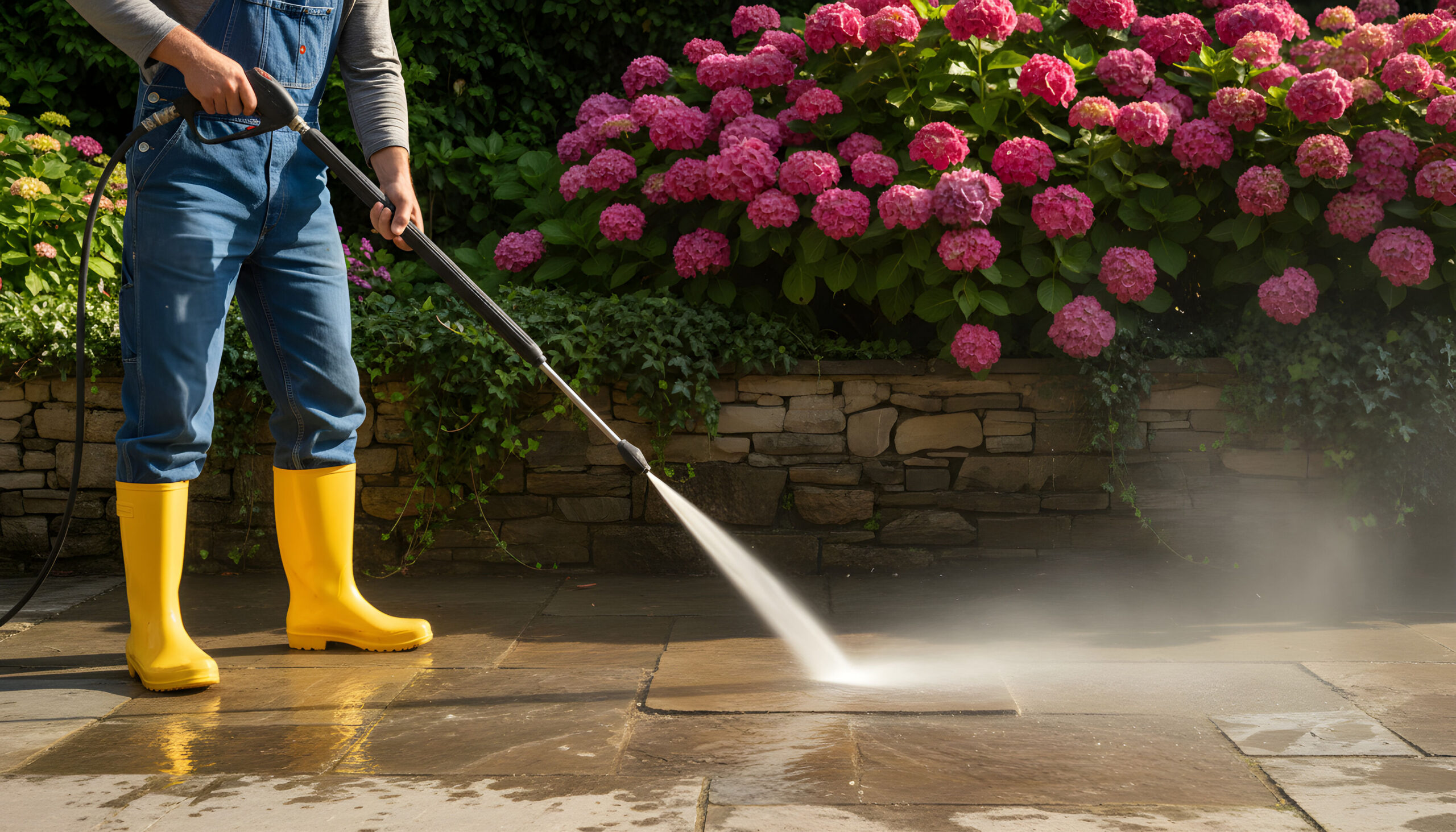
There’s a version of pressure washing that ruins things. Too much pressure on wood decking splinters the grain and drives moisture deeper in. Too close to vinyl siding forces water behind the panels. Using the wrong nozzle on concrete etches a streaky pattern you’ll be looking at for years. Done right, though, pressure washing is probably the single fastest way to change how your entire property looks.
Concrete surfaces like driveways, walkways, and the apron around your garage respond extremely well to a 3,000 PSI machine with a 25-degree nozzle, kept about 12 inches from the surface. Your siding wants something much gentler: 1,200 to 1,500 PSI, a wider fan nozzle, and a top-to-bottom direction so you’re not forcing water upward under the panels. The Family Handyman pressure washing guide walks through the nozzle choices clearly if you’re renting equipment and trying to figure out the color-coded tips.
Wooden decks are their own category. Pressure wash them if you want (500 to 600 PSI is plenty, and any more risks fuzzing the wood), but plan to follow up with a deck brightener to neutralize the grain before you apply any stain or sealant. Skipping that step and staining straight over a pressure-washed deck is a common mistake; the stain won’t penetrate evenly and you’ll see it within a season.
If your home has older painted surfaces, lead paint included, renting a machine and doing this yourself may not be the play. Professionals carry the right containment equipment and know how to handle runoff that you might not want flowing into your lawn or storm drains.
Gutters: The Least Glamorous, Most Important Task
Nobody looks forward to gutter cleaning, but clogged gutters cause a specific type of damage that’s disproportionately expensive: water follows the path of least resistance, and when that path is straight down your fascia boards and into your foundation, you’re looking at rot, mold, and potentially thousands in remediation. Clean gutters in spring before the heavy rains arrive, not after.
The actual work is more manageable than most people expect. This Old House’s gutter cleaning walkthrough covers the ladder safety logistics in detail, but here’s the basic sequence to follow:
- Clear the debris first. A gutter scoop makes this faster and less messy than using your hands. Work from one end toward the downspout.
- Flush with a hose. A curved gutter attachment lets you rinse everything toward the downspout without repositioning your ladder constantly.
- Check the downspouts. If water backs up when you flush, there’s a clog inside. A plumber’s snake or a strong burst from the hose usually clears it.
- Inspect while you’re up there. Look for sections pulling away from the fascia, standing water that signals a slope problem, or seams that have started separating. A tube of gutter sealant fixes most seam issues in about ten minutes.
- Extend your downspouts. If they’re depositing water within two feet of your foundation, add extensions. It’s a cheap fix that quietly prevents expensive problems.
Deck and Patio Surfaces: Recovery Mode
Your deck spent the winter expanding and contracting with every temperature swing, and it shows. Work through it systematically: clear everything off, sweep, then get down and actually look at the boards. Loose fasteners get tightened or replaced. Any board that’s soft when you press on it, that’s rot, and it should come out before it spreads to the joists. Don’t refinish over structural problems hoping they’ll stop progressing. They won’t.
Once the structure checks out, cleaning and refinishing is genuinely satisfying work. A good deck cleaner (look for oxygen bleach-based products rather than chlorine bleach, which degrades wood fibers over time) lifts the gray oxidation that makes old decks look tired. Let it dry fully, at least two clear days, before applying any sealant or stain. Semi-transparent stains are generally easier to recoat in future years than solid stains, which tend to peel rather than wear gracefully.
Stone and brick patios have their own rhythm. Pressure washing works well, but pay attention to the joints. Winter freeze-thaw cycles heave the polymeric sand out of joints, and once weeds find those gaps, re-jointing becomes a bigger project. Pull the weeds, blow out the joints, and repack with fresh polymeric sand before it rains. Sweep it in, mist it to activate, and those joints will hold through another season.
Setting Up for the Months Ahead
Cleanup is really just preparation in disguise. Once the visible work is done, a few decisions made now will determine how much maintenance the rest of the season actually requires.
Your irrigation system, if you have one, needs to be checked before you rely on it. Run each zone, watch for heads that aren’t rotating, spraying sideways, or simply not popping up. The EPA WaterSense program has solid guidance on smart controllers that adjust watering schedules based on weather data. They pay for themselves in reduced water bills faster than most people expect, and they prevent the peculiarly depressing sight of sprinklers running during a rainstorm.
For lawn feeding, a slow-release granular fertilizer applied in late April or early May gives cool-season grasses a long, steady nutrient supply rather than the quick surge-and-crash of fast-release products. If you don’t know your soil’s pH, a $15 test kit from any garden center will tell you whether you’re dealing with acidic or alkaline soil, because fertilizer applied to soil with the wrong pH largely goes nowhere. Your lawn’s been trying to tell you that for years, probably.
The point isn’t to do everything at once. It’s to do the right things in the right order, so that by the time summer settles in, your yard is actually where you want to be and not just another project you’re managing around.
Sources