Table of Contents
Tree Removal for Your Home Starts with Knowing When to Act
A well-timed tree removal can instantly make your home safer, brighter, and more beautiful; sometimes, it’s the upgrade your property did not even know it needed. If you have been putting it off, understanding when and why to act could save you from costly damage and give you back control of your outdoor space.
Why Tree Removal Can Actually Be a Good Thing
Most people see a tree as permanent. That’s understandable. They take decades to grow, they provide shade, and they’re usually the backdrop to every outdoor memory a family makes on a property. But here’s what often gets overlooked: a struggling tree isn’t just an eyesore. It’s a liability that compounds quietly, season after season, until one storm makes the decision for you.
Removing a damaged or diseased tree isn’t a concession. It’s often a smart landscaping move. Open up the right corner of a yard and suddenly you’ve got sunlight reaching a patio that’s been shaded for years, or space for a garden bed that actually thrives. Property values can shift, too. Buyers notice curb appeal, and a dead or leaning tree registers as a problem, not a feature. Clearing it can reframe the entire look of your exterior in ways a fresh coat of paint can’t.
The U.S. Forest Service has long documented how structurally compromised trees are significantly more likely to fail in storm conditions. The real question isn’t whether a weakened tree will eventually fall. It’s whether you’ll be the one who decides where and when.
Signs You Shouldn’t Ignore
Recognizing the warning signs early is the whole game. A sudden lean is usually the most obvious red flag, and it almost always points to root instability rather than a surface problem. Roots don’t fail overnight; by the time a lean is visible, the tree has been in trouble for a while.
Dead branches are another indicator worth taking seriously, especially large ones, or entire sections of canopy with no leaves. The same goes for deep cracks in the trunk, peeling bark that exposes soft wood underneath, and any visible decay at the base.
Fungal growth is probably the most misunderstood warning sign. Mushrooms sprouting around the base of a tree look harmless enough, but they’re often a sign of internal rot that’s already well advanced. Some trees survive partial decay and continue growing for years. Many don’t, and there’s rarely a reliable way for an untrained eye to tell the difference without a proper assessment.
What Happens If You Wait
Delay is expensive, almost without exception. A weakened tree doesn’t stabilize on its own. It deteriorates, loses structural integrity, and becomes harder to remove safely the longer it’s left standing.
Storm damage is the most common trigger for emergency removals, and emergency removals cost more. Think about the scope: high winds bring down a compromised oak, it lands on a fence, clips the corner of a roof, and blocks the driveway. That’s potentially $8,000 to $15,000 in combined property repairs for a tree removal that might have cost $1,200 done on a Tuesday in September with proper planning.
There’s also a safety dimension that doesn’t get enough attention. The CDC notes that injuries from falling debris and chainsaw-related accidents are more common in DIY tree situations than most homeowners expect. This isn’t work that forgives mistakes.
Why You’ll Want a Professional for This
It’s tempting to look at tree removal as a job for a chainsaw and a free Saturday. It isn’t. Even a relatively small tree involves complex decisions about fall direction, tension in the limbs, proximity to structures, and how to handle a trunk once it’s on the ground.
Certified arborists, which you can find through the International Society of Arboriculture, bring something beyond just equipment. They can tell you whether a tree actually needs to come down, or whether targeted pruning might stabilize it. Sometimes removal is the wrong call, and a good arborist will say so directly.
Professionals also carry liability insurance, which matters more than most people realize until something goes sideways. If an uninsured crew drops a branch through your neighbor’s greenhouse, that’s your problem. With a properly insured company, it isn’t.
Permits are another consideration that often catches homeowners off guard. Depending on your municipality, removing a tree above a certain diameter or within a certain distance of a property line may require a permit. Most professional crews handle that paperwork routinely. Most DIYers don’t know it exists until after the fact.
How the Process Actually Works
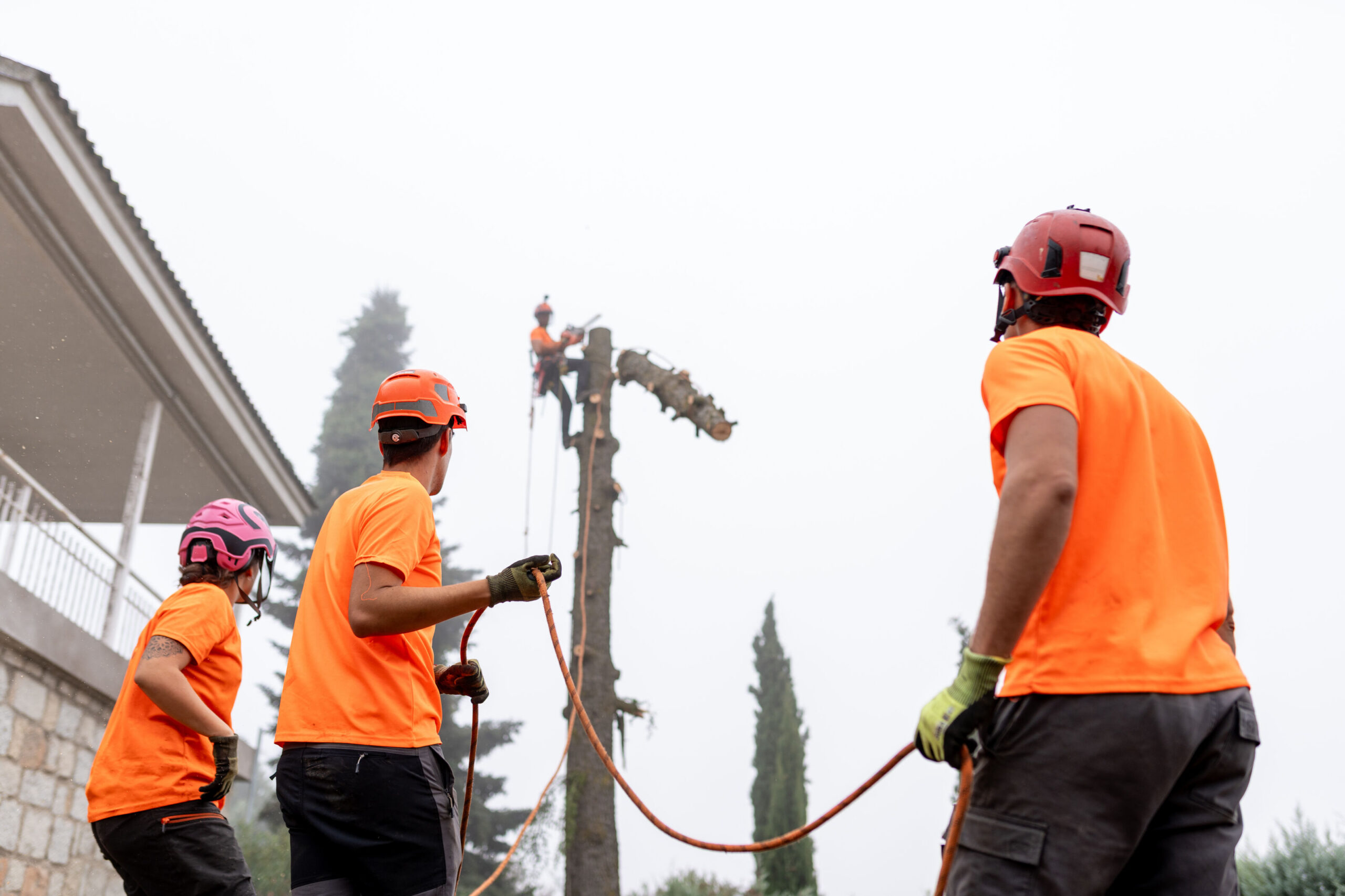
The removal itself is usually less dramatic than people expect, largely because experienced crews do it in sections rather than dropping the whole tree at once. That approach is slower, but it’s what makes the job safe when there’s a driveway, fence, or structure anywhere nearby.
Crews typically work top-down, clearing the canopy branch by branch before touching the trunk. Each piece gets guided down in a controlled way, not just dropped. Once the canopy is cleared, the trunk comes down in sections. How many sections depends on the height and positioning.
After the tree is down, you’ll have a decision to make about the stump. Leaving it isn’t always a problem, but it does become a tripping hazard over time, and it can attract insects and fungal growth if it’s left to decay in place. Stump grinding takes it below grade in an hour or two and leaves the space ready for replanting or lawn restoration. Most removal companies offer it as a separate add-on service.
What Tree Removal Actually Costs
Cost varies enough that a single number isn’t very useful, but understanding what drives the price helps you evaluate quotes intelligently.
The biggest factors are size, location, and access. A 40-foot maple in an open yard costs significantly less than a 40-foot maple growing against a garage wall. Height matters because larger trees require more time and more equipment. Location matters because tight spaces force slower, more technical removal methods. If a crew needs a crane, which happens more often than you’d expect in suburban yards with overhead lines and close structures, that adds substantially to the total.
According to This Old House, most residential tree removals average around $906, with smaller trees under 30 feet running $150 to $450 and larger trees over 80 feet reaching $1,000 to $2,000 or more. Emergency removals after storm damage can push up to $5,000. Getting three quotes before scheduling is the simplest way to establish what a fair price looks like in your area.
The Environmental Side of the Equation
It’s worth acknowledging that removing a tree carries some emotional weight for a lot of people. That’s reasonable. Trees do real environmental work, and losing one matters. But the calculus isn’t always what it seems.
A diseased tree can spread pathogens to neighboring trees and shrubs. An invasive species taking up canopy space is actively suppressing native plants that would support local pollinators and birds better. And the wood from a removed tree doesn’t have to go to a landfill. Most professional services chip it into mulch, which can be used directly in your yard, or haul it to facilities that process it into firewood or compost.
The EPA’s resource on the benefits of trees and vegetation makes clear how much healthy, well-placed trees contribute to the surrounding environment. Planting a right-sized, native replacement after a removal often results in a net ecological gain over keeping a compromised or invasive tree in place.
Keeping Your Yard Healthy Long-Term
Once the problem tree is gone, it’s a good moment to reset your approach to the rest of your yard. Regular pruning is the single most effective maintenance habit for tree health. Removing dead or weak branches before they become hazards reduces risk and encourages strong, balanced growth.
Proper watering during dry stretches matters more than most people think, especially for younger trees still establishing their root systems. When you’re planting something new, take the long view on spacing. A tree that looks fine 10 feet from your foundation right now may be causing structural problems in 20 years as the root system expands. Check mature size before you plant, not after.
Annual inspections by a certified arborist aren’t overkill if you have significant trees on your property. They’re the kind of thing that catches problems at the $300 pruning stage rather than the $3,000 emergency removal stage.
The Bottom Line
Tree removal for your home isn’t a defeat. Done thoughtfully, it’s often one of the better decisions a homeowner can make, for safety, for aesthetics, and sometimes for the health of everything else growing on the property. Don’t let an uncertain timeline turn a manageable situation into an emergency. The sooner you get a proper assessment, the more options you’ll have.
Sources